Pickleball Rules for Beginners: How to Play, Score and Serve (2026 Guide)
Daily Leaflet
27 minutes readPickleball is everywhere. Tennis courts are being repainted with extra lines, community centers have waiting lists, and friends who never played a racket sport are suddenly talking about "dinks" and "the kitchen". According to the Sports & Fitness Industry Association, more than 24 million Americans played pickleball in 2025, and it has been the fastest-growing sport in the United States for several years in a row. It is booming in Canada and the UK too, and more new players than ever are looking up the pickleball rules before their first game.
The good news is that pickleball is easy to pick up. The not-so-good news is that a few of the pickleball rules confuse almost every beginner: why you have to let the ball bounce twice, where you can and cannot stand, and why the score has three numbers. This guide explains all of it in plain English, based on the current USA Pickleball Official Rulebook (2026 edition). You will learn how the court is laid out, what equipment you need, how to serve legally, the two-bounce rule, the kitchen rules, how scoring works in doubles and singles, the most common faults, basic etiquette and simple strategy to help you win your first games.
- Serve underhand and diagonally. Hit the ball below your waist, from behind the baseline, into the service court across from you. It must clear the kitchen.
- Let it bounce twice. The return of serve must bounce, and the next shot must bounce too. After that, you can volley (hit the ball in the air).
- Stay out of the kitchen when volleying. You cannot hit a ball out of the air while standing in the 7-foot zone next to the net, or on its line.
- Only the serving side scores (in traditional scoring). Games are usually played to 11, and you must win by 2.
- Lines are in, except that a serve landing on the kitchen line is a fault.
What Is Pickleball?
Pickleball is a paddle sport that mixes elements of tennis, badminton and table tennis. Two players (singles) or four players (doubles) hit a light, perforated plastic ball over a low net using solid paddles. The court is the same size as a badminton doubles court, which is much smaller than a tennis court, so there is less running and more quick reactions at the net. Most people play doubles, and that is where most beginners start.
Because the ball is slow and the court is small, pickleball is easy for beginners of almost any age and fitness level. At the same time, the best players hit fast, spinning shots and play long, tactical rallies, so there is always something new to learn.
A short history of pickleball
Pickleball was invented in the summer of 1965 on Bainbridge Island, near Seattle in Washington State. Joel Pritchard, a politician who later served in the US Congress, and his friend Bill Bell came home to find their families bored. They tried to set up a game of badminton but could not find a full set of rackets, so they improvised with table tennis paddles and a perforated plastic ball. They soon lowered the badminton net, and a few days later their friend Barney McCallum joined in. Together, the three men created the first rules, with the original goal of making a game the whole family could enjoy.
There are two popular stories about the name. One says it came from the Pritchards' dog, Pickles, who loved to chase the ball. The other, told by Joan Pritchard, says it was named after the "pickle boat" in rowing, the crew made up of leftover rowers, because the game borrowed bits from several other sports. Whichever story you believe, the name stuck. Pickleball spread slowly for decades before exploding in popularity in the 2020s, and in 2022 it was named the official state sport of Washington.
Today, the sport's rules in the United States are published by USA Pickleball, the national governing body, and updated every year. Many national organizations, including Pickleball Canada, use the same rulebook. The pickleball rules in this guide follow that rulebook. If you enjoy reading about the history of big sports, you might also like our guide to every FIFA World Cup winner since 1930.
The Pickleball Court: Size and Lines
A pickleball court is a rectangle 20 feet wide and 44 feet long (about 6.1 m by 13.4 m). The same court is used for singles and doubles, which is one of the things that makes pickleball rules simpler than tennis. Many pickleball courts are painted on top of tennis courts, and you can fit up to four pickleball courts in the space of one tennis court.
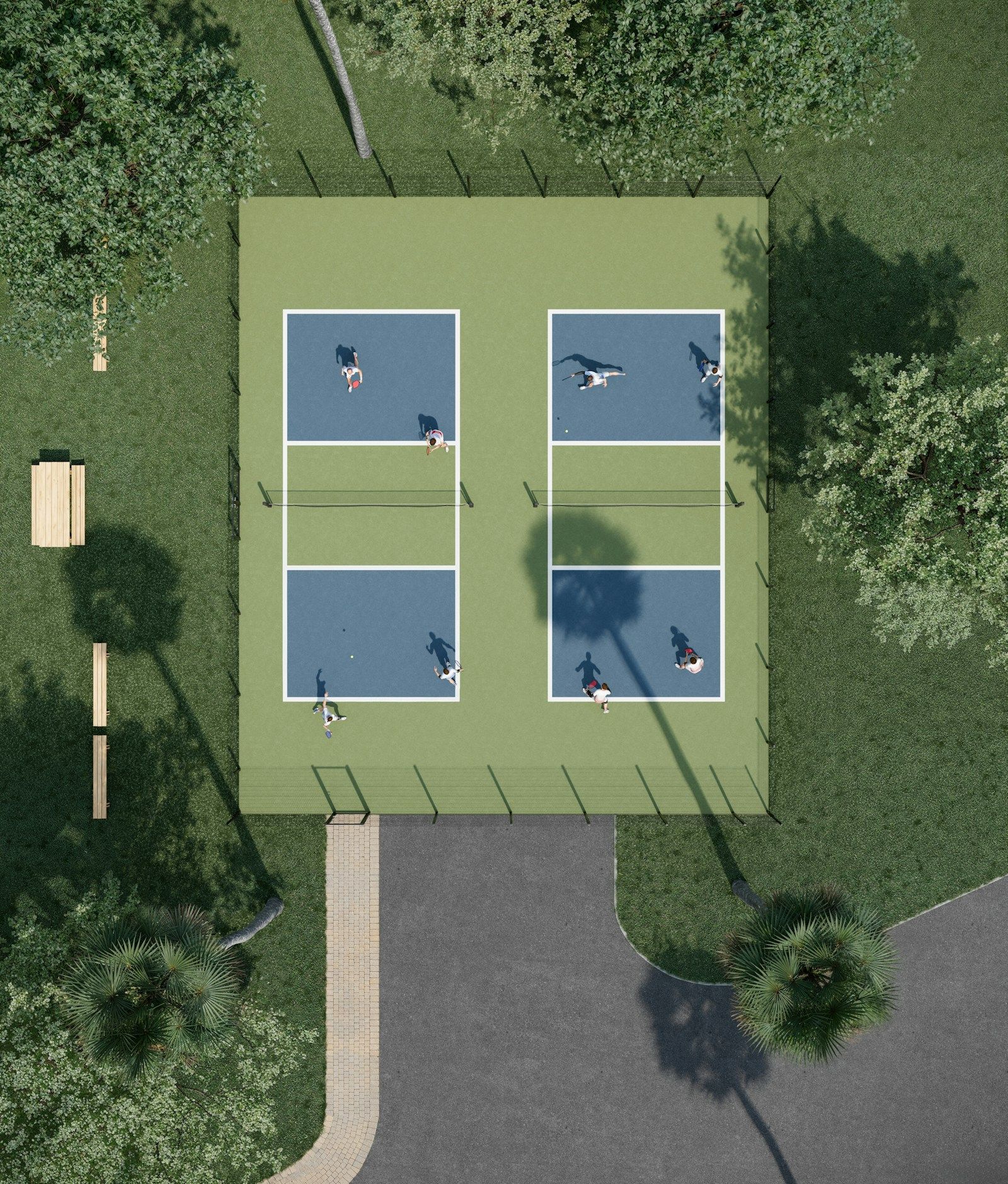
Here are the parts of the court you need to know:
- Baseline: the line at the back of the court, parallel to the net. You serve from behind it.
- Sidelines: the lines on each side of the court, running from the baseline to the net.
- Non-volley zone (the kitchen): the area that runs 7 feet back from the net on both sides. Its back edge is called the non-volley line or kitchen line.
- Centerline: the line that runs from the kitchen line to the baseline, splitting each side into two service courts.
- Service courts: the right-hand (even) and left-hand (odd) courts on each side, each 10 feet wide and 15 feet deep. The kitchen is not part of the service court.
The net is 36 inches (91.4 cm) high at the sidelines and 34 inches (86.4 cm) high in the center. That is lower than a badminton net and slightly lower than a tennis net, and the dip in the middle is why many shots are aimed down the center.
| Court feature | Measurement |
|---|---|
| Court size (singles and doubles) | 20 ft x 44 ft (6.1 m x 13.4 m) |
| Non-volley zone (kitchen) | 7 ft from the net on each side |
| Each service court | 10 ft wide x 15 ft deep |
| Net height at the sidelines | 36 in (91.4 cm) |
| Net height at the center | 34 in (86.4 cm) |
| Line width | 2 in (5 cm) |
Pickleball Equipment
One reason pickleball has grown so quickly is that it is cheap to start, and the pickleball rules for equipment are relaxed for casual play. You need three things: a paddle, a ball and comfortable shoes.
1. A paddle
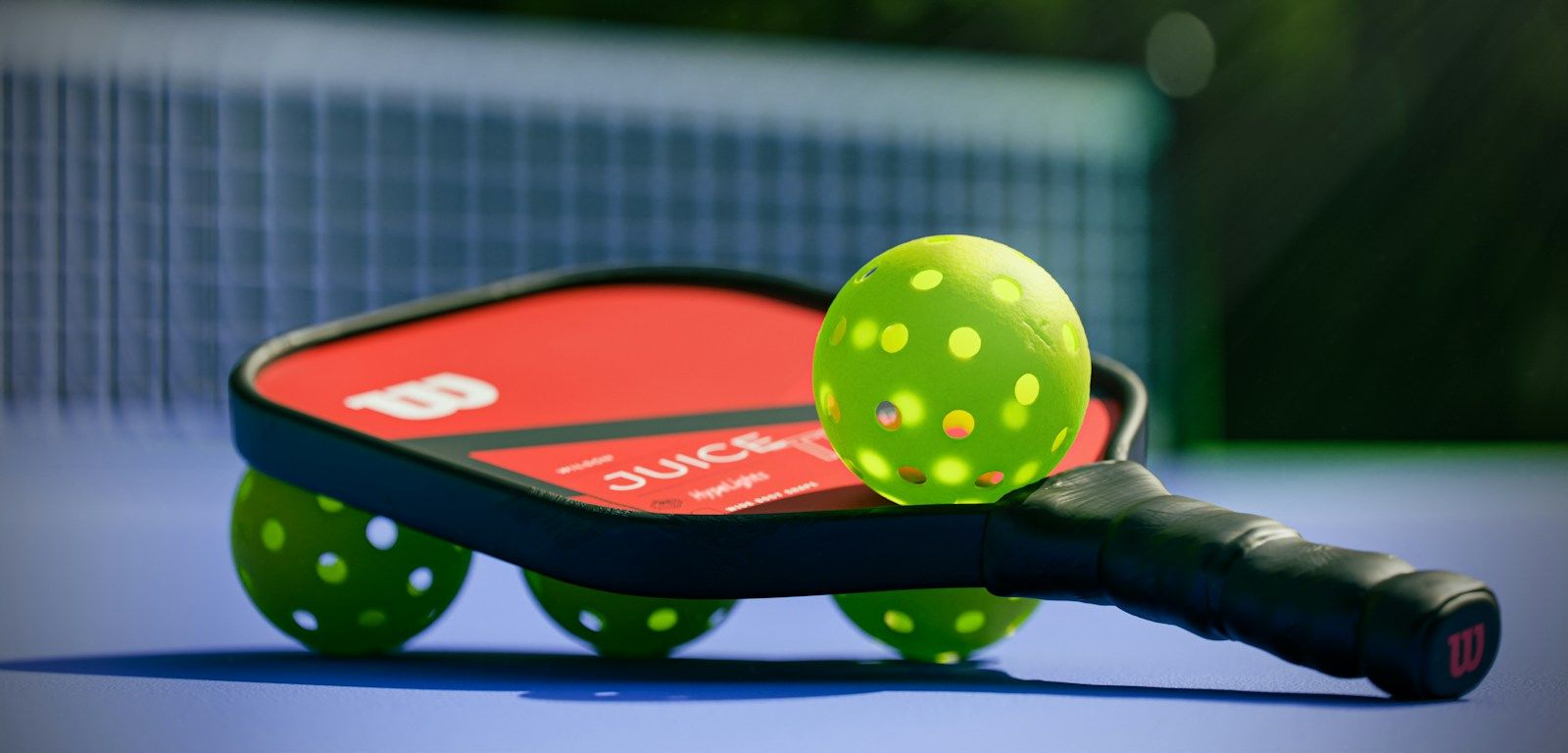
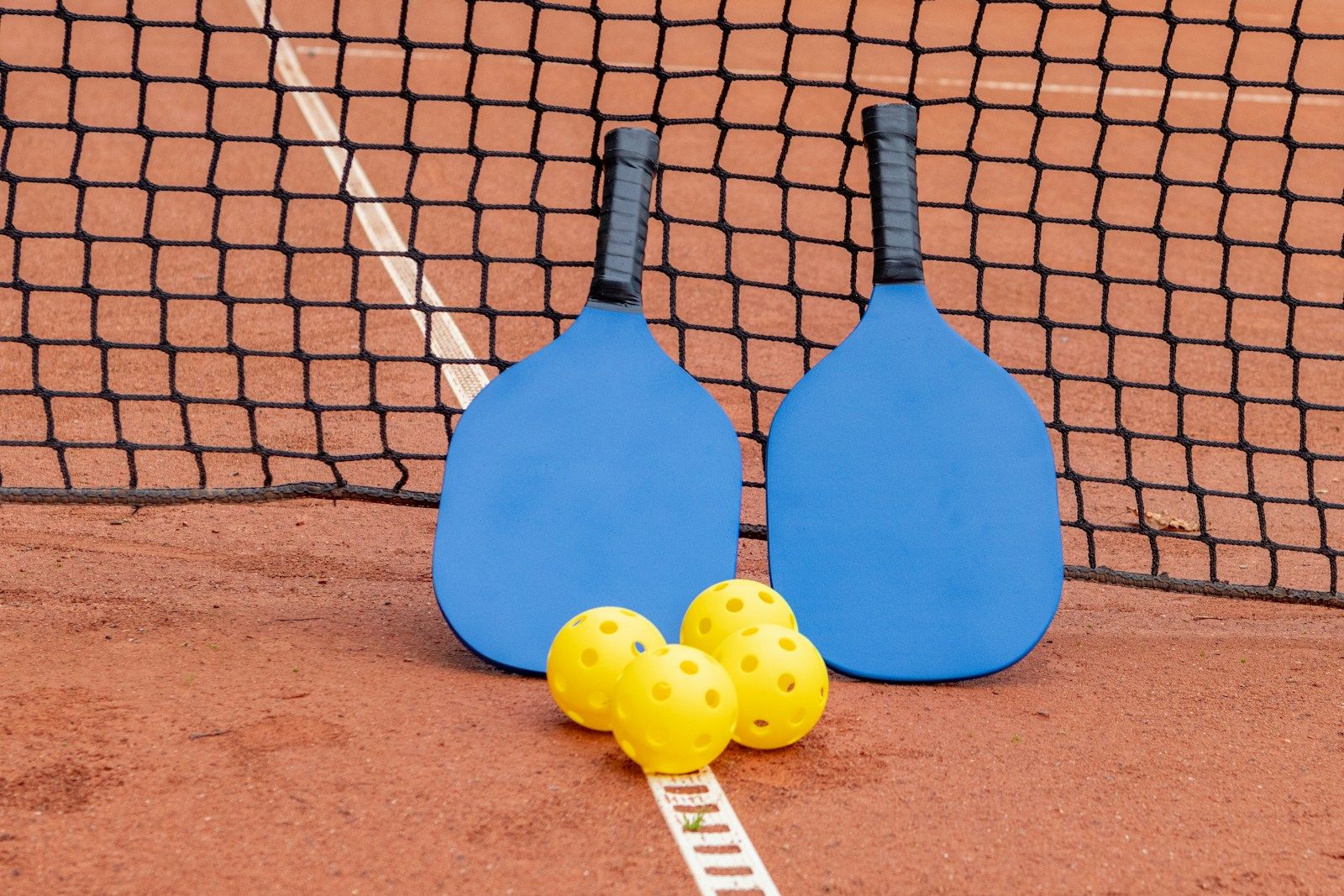
Pickleball paddles are solid, with no strings. They are bigger than a table tennis paddle and smaller than a tennis racket. Under the USA Pickleball equipment standards, the combined length and width of a paddle cannot be more than 24 inches, and its length cannot be more than 17 inches. Most paddles weigh between about 7 and 8.5 ounces. Beginner paddles are usually made with a polymer core and a fiberglass or graphite face, and they cost far less than a high-end carbon fiber paddle.
For casual play, any paddle is fine. If you plan to play in sanctioned tournaments, your paddle must be on USA Pickleball's list of approved paddles. Most brands print an approval mark on the paddle or the packaging.
2. A ball
Pickleballs are hard plastic balls with holes, a little smaller than a softball. Approved balls have between 26 and 40 holes. There are two main types:
- Outdoor balls: heavier and harder, with more, smaller holes (often 40). They handle wind better but can crack in cold weather.
- Indoor balls: lighter and softer, with fewer, larger holes (often 26). They are slower and easier to control in a gym.
3. Shoes and clothing
Wear court shoes with good side support, such as tennis or indoor court shoes. Running shoes are designed for forward movement and can cause ankle injuries during quick side-to-side steps. Otherwise, wear anything comfortable that you can move in, and bring water. Many players also wear protective eyewear, because the ball can come at your face quickly at the net.
How to Serve: Pickleball Rules for the Serve
Every rally starts with a serve, and the serving pickleball rules are stricter than in tennis. The serve is meant to start the point, not to win it, so it must be hit with a gentle, underhand-style motion. You get only one attempt; there is no second serve.
Where to stand and where to aim
- At the moment you hit the ball, at least one foot must be on the ground behind the baseline.
- Neither foot may touch the baseline or the court in front of it, and your feet must stay within the imaginary extensions of the sideline and centerline of your service court.
- You must serve diagonally, into the opponent's service court across from you.
- The serve must clear the kitchen. A serve that lands in the kitchen or on the kitchen line is a fault. A serve that lands on the centerline, sideline or baseline of the correct service court is in.
- A serve that touches the net and still lands in the correct service court is in play. There are no "let" serves for net touches in pickleball.
Option 1: The volley serve
The traditional serve is the volley serve, where you hit the ball out of the air without letting it bounce. You can use a forehand or a backhand. For a volley serve to be legal:
- Your paddle must be moving in a clear upward arc when it makes contact with the ball.
- The highest point of the paddle head must not be above the highest part of your wrist when it hits the ball.
- The ball must be no higher than your waist when you hit it.
In the 2026 rulebook, USA Pickleball added the word "clearly" to these rules to make them easier to enforce, and the upward arc now refers to the paddle rather than the arm. In practice, it means flat, sidearm-style serves are not allowed.
Option 2: The drop serve
The drop serve is easier for many beginners. You simply drop the ball and hit it after it bounces. To be legal, the ball must be dropped from a natural height. You cannot throw it down, toss it up or bounce it off the paddle. Once it has bounced, you can hit it any way you like, because the upward arc, wrist and waist rules for the volley serve do not apply to the drop serve.
Releasing the ball and spin
You may release the ball with one hand or drop it off the face of your paddle. You must not add spin to the ball with your fingers or hand as you release it (the old "chainsaw" spin serve is illegal). However, under the current pickleball rules, you can add spin with the paddle at the moment of contact, as long as every other serving rule is followed. In casual games, the receiver must be able to see the release.
Other serving rules to remember
- Call the score first. The server must call the full score before serving.
- The 10-second rule: once the score has been called, the server has 10 seconds to serve.
- Which side to serve from: the first serve of every side-out is made from the right-hand court. After each point the serving team wins, the server switches sides and serves to the other diagonal.
The Two-Bounce Rule
The two-bounce rule (sometimes called the double-bounce rule) is one of the most important pickleball rules and the one beginners forget most often. It works like this:
- The serving team serves the ball. The receiving team must let it bounce before returning it.
- The receiving team returns the ball. The serving team must also let it bounce before hitting it.
- After those two bounces, either team may volley the ball (hit it out of the air) or play it off the bounce.
The reason for this rule is simple. Without it, the serving team could rush the net and smash the return before the receivers had a chance. The two-bounce rule takes away that advantage and leads to longer, more interesting rallies. It is also why the serving team usually stays back near the baseline after serving, while the receiving team can move forward toward the net after returning the serve.
Do not confuse this with a ball that bounces twice on your side during a rally. At any point in the rally, if the ball bounces twice on your side before you hit it, your team loses the rally.
The Kitchen (Non-Volley Zone) Rules
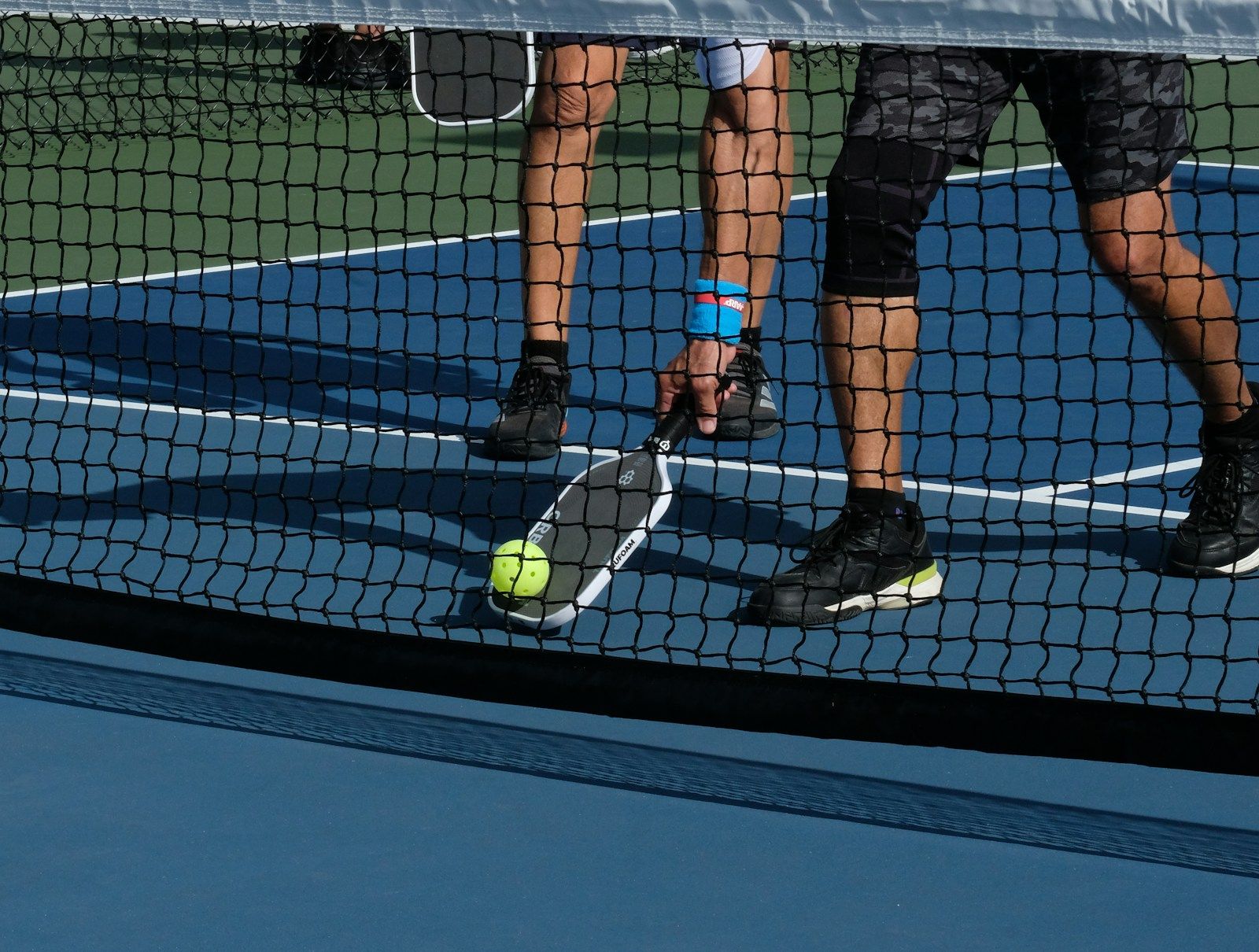
The non-volley zone, almost always called the kitchen, is the 7-foot area on each side of the net. It exists to stop players from standing right at the net and smashing every ball down at their opponents. The kitchen rules are the part of the pickleball rules that cause the most arguments, so it is worth learning them properly.
What you cannot do
- You cannot volley while touching the kitchen. If any part of your body is touching the kitchen or the kitchen line when you hit a ball out of the air, it is a fault.
- Your momentum cannot carry you in. If you volley a ball and your follow-through or momentum carries you, your paddle or anything you are wearing into the kitchen, it is a fault, even if the ball is already dead. The volley is not finished until you have regained your balance.
- You cannot drop your paddle or hat into the kitchen during the act of volleying. Anything you wear or carry counts as part of you.
- You cannot jump in and out to cheat the rule. If you have been in the kitchen for any reason, you must have both feet back on the ground outside the kitchen before you can volley.
What you can do
- You can go into the kitchen at any time to hit a ball that has bounced. The kitchen is not off limits; only volleying from it is.
- You can stay in the kitchen as long as you like, although it leaves you open to fast shots at your feet.
- You can volley while standing right behind the kitchen line, as long as you do not touch the line.
- You can reach over the kitchen with your paddle to volley a ball, as long as your feet are outside the kitchen and you do not touch the line or the net.
Many beginners think the pickleball rules ban the kitchen completely, so they never step in to reach a short ball. Do not make that mistake: if the ball has bounced, go and get it.
How Scoring Works
Scoring is the other part of the pickleball rules that confuses new players, mostly because doubles uses three numbers. Once you understand the logic, it quickly becomes second nature.
Traditional (side-out) scoring
Most recreational games and many tournaments use traditional side-out scoring, the default system in the official pickleball rules:
- Only the serving team can score a point. If the serving team wins the rally, it scores a point and the same player serves again from the other side.
- If the receiving team wins the rally, no point is scored. Instead, the serve moves to the next server or to the other team.
- Games are normally played to 11 points, and you must win by 2. Tournament games may be played to 15 or 21 points, still win by 2.
The three-number score in doubles
In doubles, both players on a team get a turn to serve before the serve passes to the other team (a "side-out"). That is why the score in doubles has three numbers:
- The serving team's score
- The receiving team's score
- The server number: 1 if it is the first server on that team, or 2 if it is the second
So a call of "4–2–1" means the serving team has 4 points, the receiving team has 2 points, and the first server is serving. If that team loses the rally, the score becomes "4–2–2" and the partner serves. If they lose again, it is a side-out and the other team serves, calling the score from their point of view: "2–4–1".
Why every game starts at "0–0–2"
At the start of a game, the team that serves first only gets one server before a side-out. This stops the first team from getting an unfair head start. To show this, the first serve of every doubles game is called "0–0–2", as if the first server were already the second server. When that team loses a rally, the serve goes straight to the other team, who start at "0–0–1".
Which side should you be on?
Here is a simple way to check that everyone is in the right place. The player who served first for your team at the start of the game should be in the right-hand court when your team's score is even (0, 2, 4, 6, 8, 10) and in the left-hand court when it is odd (1, 3, 5, 7, 9). Players on the serving team only switch sides after winning a point. The receiving team never switches sides on its own.
Rally scoring
Some events and leagues now use rally scoring, where a point is scored on every rally, no matter which team served. USA Pickleball has provisionally approved rally scoring as an option for tournament directors. In the 2026 rulebook, the old rule that game point could only be won by the serving team was removed, so under rally scoring either team can now win the final point. Rally scoring games can be played to 11, 15 or 21 points. In doubles rally scoring, each team has only one server per turn, so the score is called with just two numbers, like in singles. If you are joining a league or tournament, always check which version of the pickleball rules for scoring it uses.
Pickleball Rules for Singles vs Doubles
The basic pickleball rules are the same in singles and doubles, which makes switching between them easy: the same court, the same serve, the two-bounce rule and the kitchen. The main differences are in serving and scoring.
| Singles | Doubles | |
|---|---|---|
| Players | One on each side | Two on each side |
| Court size | 20 ft x 44 ft | 20 ft x 44 ft |
| Servers per side-out | One | Two (except at the start of the game) |
| Score call | Two numbers: server's score, receiver's score | Three numbers: serving team, receiving team, server number |
| Where to serve from | Right side when your score is even, left side when it is odd | Right side at the start of each side-out, then switch after each point won |
| Fitness level | More running and more demanding | Less running, more teamwork and net play |
Most beginners start with doubles, because there is less ground to cover and you learn faster by playing with a partner. Singles is a great workout once you are comfortable with the basics.
Faults and Line Calls
A fault is any action that breaks the pickleball rules and ends the rally. If the receiving team commits a fault, the serving team wins a point. If the serving team commits a fault, the server loses the serve (in doubles, the serve passes to the partner or the other team). The most common faults are:
- The serve does not land in the correct service court, or lands in the kitchen or on the kitchen line.
- The ball is hit into the net or does not clear it.
- The ball is hit out of bounds.
- A player volleys the ball before it has bounced once on each side (breaking the two-bounce rule).
- A player volleys while touching the kitchen, or their momentum carries them into it after a volley.
- The ball bounces twice on a player's side before they hit it.
- A player, their clothing or their paddle touches the net or the net post while the ball is in play.
- The ball in play hits a player or anything they are wearing or carrying (other than the paddle or the hand holding it).
- The ball hits a permanent object, such as a fence or a light pole, before it bounces on the court.
- The server breaks a service rule, such as foot position or the volley serve motion.
Line calls
In casual games with no referee, players call the lines on their own side of the court. These are the key line-calling pickleball rules:
- A ball that touches any part of a line is in, except for a serve that lands on the kitchen line, which is a fault.
- If you are not sure, the ball is in. Players must give their opponents the benefit of the doubt.
- Make your calls promptly. The 2026 rulebook tightened the rule on out calls, so you should call "out" as soon as you know, rather than waiting until the next serve.
- Do not ask spectators. Under the 2026 rules, players must not ask spectators to help with line calls.
Pickleball Rules Cheat Sheet
Save or print this quick-reference table of the most important pickleball rules for your next game.
| Rule | What it means |
|---|---|
| Court | 20 ft x 44 ft for singles and doubles. Net 36 in at the sides, 34 in in the middle. |
| Serve | One attempt, diagonal, from behind the baseline. Must clear the kitchen and its line. |
| Volley serve | Paddle moving upward, paddle head below the wrist, ball no higher than the waist. |
| Drop serve | Drop the ball from a natural height (no throwing), then hit it after it bounces. |
| Net serves | A serve that touches the net and lands in the correct court is in play. |
| Two-bounce rule | The return of serve and the next shot must both bounce before anyone volleys. |
| Kitchen | No volleying while touching the 7-ft zone or its line, including momentum after a volley. |
| Scoring | Traditional: only the serving side scores. Games to 11, win by 2. |
| Doubles score | Three numbers: serving team, receiving team, server number. Start at 0–0–2. |
| Rally scoring | A point on every rally. Used as an option in some events and leagues. |
| Lines | Lines are in, except a serve on the kitchen line. If in doubt, call it in. |
| Time to serve | 10 seconds after the score is called. |
Pickleball Etiquette
Beyond the official pickleball rules, the sport has a friendly, social culture, and knowing a few unwritten rules will make you very welcome at any court.
- Call the score loudly and clearly before every serve, so everyone knows where the game stands.
- Make fair line calls. Call the lines on your side honestly, and if you did not see it clearly, give it to your opponents.
- Tap paddles at the net with your opponents at the end of a game and say "good game".
- Wait for the rally to end before walking behind or across a court where others are playing.
- Call "ball on court" if a stray ball rolls onto your court, and stop play. The point is replayed.
- Follow the court's system for waiting players. Many public courts use a paddle rack or a board, where you place your paddle in line to join the next game.
- Help new players. Everyone was a beginner once. Explaining a rule kindly goes a long way.
- Avoid aiming at people's bodies in friendly games, especially with new players or at close range.
Beginner Strategy
Once you know the pickleball rules, these simple tactics will help you win more rallies. You do not need to hit the ball hard to win at pickleball. Consistency and good positioning beat power at every beginner level.
- Get your serve and return in, and deep. Missing a serve gives away your turn. Aim for the middle of the court and the back third, and focus on consistency rather than speed.
- After returning the serve, move up to the kitchen line. The team at the net usually controls the rally. Because of the two-bounce rule, the receiving team gets there first, so take advantage of it.
- If you are serving, be patient. Stay back until the return bounces, then try to work your way forward together with your partner.
- Learn the third-shot drop. This is a soft shot hit by the serving team that drops into the opponents' kitchen. It gives you time to move up to the net. It takes practice, but it is the most important shot in the game.
- Learn to dink. A dink is a soft shot from the kitchen line that lands in your opponents' kitchen. It is hard to attack because it bounces low.
- Keep your paddle up and in front of you. At the net, the ball comes back fast. A ready position with the paddle at chest height will save you many points.
- Talk to your partner. Call "mine", "yours" or "bounce" so you do not both go for the same ball, or both leave it. A common rule is that the player with the forehand in the middle takes shots down the center.
- Move as a team. Try to move forward, back and side to side together, like you are connected by a rope, so you do not leave a big gap in the middle.
Like any sport, pickleball rewards regular practice. Even two or three short sessions a week will make a big difference in your first month. If you are trying to fit more exercise into a busy week, our guide on how to build a morning routine that sticks has tips for building new habits, and an early game of pickleball is a great way to start the day.
Common Beginner Mistakes
Almost every new player makes these mistakes when learning the pickleball rules. Knowing them in advance will help you avoid giving away easy points.
- Forgetting the two-bounce rule: Rushing forward after serving and volleying the return is one of the most common beginner faults. Serve, stay back and let the return bounce.
- Kitchen foot faults: Stepping on the kitchen line while volleying, or falling into the kitchen after a volley. Stand a small step behind the line and stay balanced.
- Staying at the baseline: Players who stay back all rally give their opponents easy angles. Move up to the kitchen line whenever it is safe.
- Hitting everything hard: Fast shots often go into the net or out of bounds, and a hard shot at players standing at the net usually comes straight back. Soft, low shots win more points.
- Losing track of the score: Use the even and odd rule to check your positions, and call the score every time you serve.
- Swinging too big: Pickleball needs short, compact swings, especially near the net. Big tennis-style backswings make you late and less accurate.
- Watching your partner instead of the ball: Keep your eyes on the ball and be ready, even when it is not coming to you.
- Wearing the wrong shoes: Running shoes and quick sideways steps are a common cause of ankle injuries. Invest in court shoes early.
To read the full, official wording of every rule, including the detailed rules for tournaments, see the USA Pickleball Official Rulebook and its shorter summary of the rules. For the latest participation figures, see the SFIA's US pickleball participation research.
Frequently Asked Questions
What are the basic pickleball rules?
The basic pickleball rules are: serve underhand and diagonally from behind the baseline, let the return of serve and the next shot both bounce (the two-bounce rule), do not volley while standing in the 7-foot kitchen next to the net, and keep the ball in bounds. In traditional scoring, only the serving team scores, and games are played to 11, win by 2.
Can you step in the kitchen in pickleball?
Yes. You can step into the kitchen at any time to hit a ball that has bounced, and you can stay there. The only thing you cannot do is volley (hit the ball out of the air) while touching the kitchen or its line, or let your momentum carry you into the kitchen after a volley.
Does the serve have to be underhand in pickleball?
Yes, in effect. For a volley serve, the paddle must move in an upward arc, the paddle head must be below your wrist and you must hit the ball no higher than your waist. You can also use a drop serve, where you drop the ball, let it bounce and then hit it, and the motion rules do not apply.
What happens if the serve hits the net?
Under the current pickleball rules, a serve that touches the net and lands in the correct service court is in play, and the rally continues. There is no replay. If it touches the net and lands in the kitchen or out of bounds, it is a fault.
Why are there three numbers in the pickleball score?
In doubles, the score is the serving team's score, the receiving team's score and the server number (1 or 2), because both players on a team usually get to serve before a side-out. Singles only uses two numbers.
What does "0–0–2" mean at the start of a game?
It means neither team has scored, and the first server is treated as the second server. This rule means the team that serves first only gets one server before the serve passes to the other team, so they do not get an unfair advantage.
Is rally scoring now the official pickleball scoring?
Not yet. Traditional side-out scoring is still the standard. Rally scoring, where a point is scored on every rally, is a provisionally approved option that tournament directors and leagues can choose to use. Always check before you play in an organized event.
Is pickleball easy to learn?
Yes. Most people can learn the pickleball rules and play a fun game in their first session, especially in doubles. The small court, slow ball and underhand serve make it much easier to start than tennis, although it takes time and practice to master the soft game at the net.
Final Thoughts
Pickleball is easy to start, very social and a great way to stay active at any age. Once you understand a handful of key pickleball rules, the underhand diagonal serve, the two-bounce rule, the kitchen and the three-number score, you are ready to join a game at your local court. Start with doubles, focus on getting the ball in rather than hitting it hard, and do not worry about making mistakes. Every player you meet on the court was a beginner once.
Have you played pickleball yet, or which rule confused you the most? Share it in the comments below, and explore more sports guides on Daily Leaflet.
Image credits
- Paddle and balls: Photo by Brendan Sapp on Unsplash
- Pickleball courts: Photo by Brian Zajac on Unsplash
- Play at the net: Photo by eedgar ivann on Unsplash
- Paddles at the net: Photo by Alex Saks on Unsplash